Interview with Adis Ožegović
 Ajla Dizdarevic
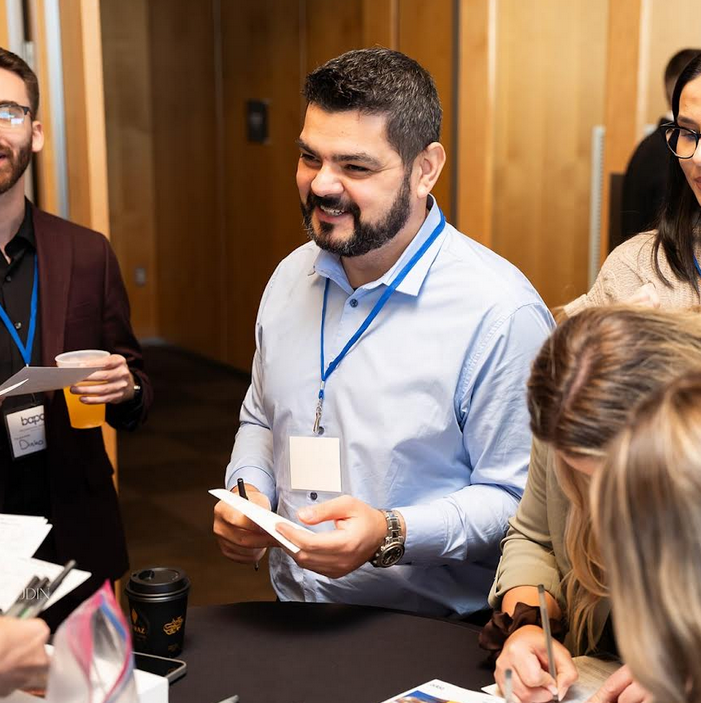
Adis Ožegović is the Vice President of Engineering at Gladiator Technologies, where he leads a team of engineers and technicians to develop and deliver innovative solutions for the defense and aerospace industry. Ožegović has over 10 years of experience in electronics and industrial engineering. He received his B.S. and M.S. in electrical engineering from the University of Washington. Ožegović is a BAPA Gold Member.
Can you describe your occupation, including your title, industry, duties, and the impact your actions have in your field?
I work as a vice president of engineering in the aerospace industry, where I lead teams developing high-performance inertial sensors and navigation systems. Think of it as sensors that measure rotation and acceleration, devices used to land an airplane or detect if your iPhone is in portrait or landscape mode. My role sits at the intersection of hardware, firmware, and customer expectations, so I’m responsible for technical direction and for building and scaling highly technical teams.
What I enjoy most is seeing something go from an idea to a fully qualified system. There’s a real sense of responsibility in that, but also pride. Beyond the technical side of things, I’ve learned that the biggest impact often comes from people and creating an environment where others can grow, collaborate, and do their best work. That’s something I take seriously, and honestly, it’s what makes the job meaningful for me.
How did you get your start in engineering?
I didn’t have a perfectly linear path into this field. My path to engineering was shaped early on by a mix of circumstances that, looking back, pushed me in that direction. I was born in Bosnia and had early exposure to the realities of war, which gave me a certain perspective on stability and opportunity at a young age. At the same time, I was fortunate to have a strong foundation in math, which became something I naturally gravitated toward.
When I came to the US, I leaned into that strength and pursued electrical engineering at the University of Washington. I started out in hands-on technical roles, working closely with hardware and troubleshooting systems to learn how things behave in the real world, not just on paper.
Over time, that evolved into more complex work and eventual leadership, but my early foundation still shapes how I think today. It also gave me a deep appreciation for how far I’ve come, which is something that continues to motivate me both professionally and personally.
How has working in your industry strengthened your connection to the Bosnian community?
Bosnia is not known for its aerospace industry, but I have met so many Bosnians across the United States, Germany, and England operating in crucial roles at their respective companies. The business that my company buys electrical boards from has five Bosnians working there, and the head of sales of the company supplying high-end motors to mine is from Vratnik, a neighborhood in Sarajevo. Malo nas je, al’ nas ima. There’s a shared understanding among Bosnians, especially those of us who grew up between cultures, that drives a strong work ethic and appreciation for opportunity. I see that reflected in my own journey and the journeys of others I meet professionally.
I’m also very intentional about staying connected. Whether that’s through community organizations, mentoring, or simply staying engaged with other Bosnian professionals, I’ve realized how important it is to build something collectively beyond the workplace.
What advice do you have for Bosnian-American professionals who want to join your industry and succeed like you?
Focus on building a strong technical foundation early on, but don’t stop there. In industries like aerospace, attention to detail and discipline are critical, but so is communication and the willingness to take risks. The engineers who stand out and are highly valued are the ones who know their craft technically, but who can also walk into a room with customers and engage on a human level.
Also, stay connected to your community. There’s a lot of untapped support and knowledge within the Bosnian-American network. At the same time, don’t forget to enjoy the process, build a life outside of work, stay active, travel when you can, and surround yourself with people who challenge and support you. That balance matters more than people think.
How did you learn about BAPA, and what prompted you to support the organization as a Gold Member?
Early on, when Kanita Lipjankić started BAPA, she organized BAPA’s first conference in Seattle, and that’s where I first found out about the organization.
Becoming a Gold Member felt like a natural step. I see it as a way to contribute to something bigger than myself, helping build a stronger, more connected network for the next generation. I also value being part of a group that brings people together not just professionally, but socially. At the end of the day, those relationships are what make communities strong, and it’s something I’m proud to be part of.