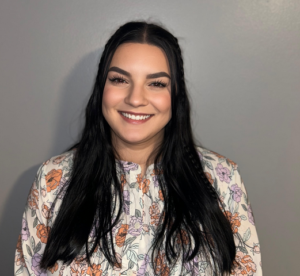
Interview with Elmedina Brkić
 Ajla Dizdarevic
Elmedina Brkić earned her bachelor’s degree from the University of Louisville, where she studied middle and secondary education with a focus on biology. She earned her master’s degree from the University of Jyväskylä in Finland, studying development, education, and international cooperation. Brkić has worked as a case manager in the pharmaceutical industry and currently lives in Amsterdam in the Netherlands.
Can you describe your occupation, including your title, industry, duties, and the impact that your actions have in your field?
For the past two years, I worked as a case manager in the pharmaceutical industry, serving as a liaison between patients, doctor offices, and pharmacies. I ensured all paperwork was filled out properly and that everyone knew what was going on. Despite needing some medical knowledge, it’s really a job focused on communicating with people.
What steps have you taken over the years to advance in your industry?
Along with earning two degrees, I lived abroad twice and worked/volunteered in areas that focus on people’s needs. During my time at the University of Jyväskylä, I served as a board member for Erasmus Student Network (ESN) Jyväskylä and AIESEC. As a board member, I helped plan events, organise meetings, recruit members, and chaperone student trips.
How have you strengthened your connection to the Bosnian diaspora?
I completed my master’s thesis on the Bosnian diaspora in Finland. Titled “The interlacing of many worlds: Bosnian Finnish connection to Bosnia and Herzegovina today,” my thesis is written in English and stored in an open access database outside of the Balkans, ensuring that this information is widely accessible.
For my thesis, I conducted interviews with 13 individuals of full-Bosnian heritage residing in four major cities in Finland. Most of the participants maintained active family ties with Bosnians in other European countries as well as the United States. From what I discovered, the most active Bosnian community was located in Turku, and their community center made attempts for the diaspora to participate in Bosnian elections.
What has been a memorable project for you, and what did it teach you?
During graduate school, I assisted two Bosnian exchange students from Sarajevo with settling in at the University of Jyväskylä. It made me realise how Bosnian and American I am. For example, I introduced the two students to Taco Bell in Jyväskylä before Taco Bell came to Sarajevo. For me, I’ve had Taco Bell since I was a little girl due to growing up in Indiana and Kentucky. It’s these little details that made me realise both how similar and different my childhood was compared to fully Balkan counterparts.
What advice do you have for Bosnian-American professionals?
Network with the Bosnian and Balkan diasporas in other countries. Doing so will expose you to different aspects of Europe outside of the Balkans.
You’re currently living in the Netherlands looking to pivot careers. What are some interesting things you’ve learned since moving there?
Amsterdam is considered the birthplace of the modern stock market! The Dutch had colonies in what is now New York, but then the British Empire outcompeted them.
Additionally, the Dutch have this tradition of strategically placing their children in the forest at night, and the children need to work together on how to get out. Adults are quietly observing the youngsters nearby without them noticing. This tradition is practiced because many Dutch people believe this allows children to grow in confidence and competence.
The Dutch are also known for their tulips, but the flower was introduced to the Netherlands in 1593 from the Ottoman Empire.